
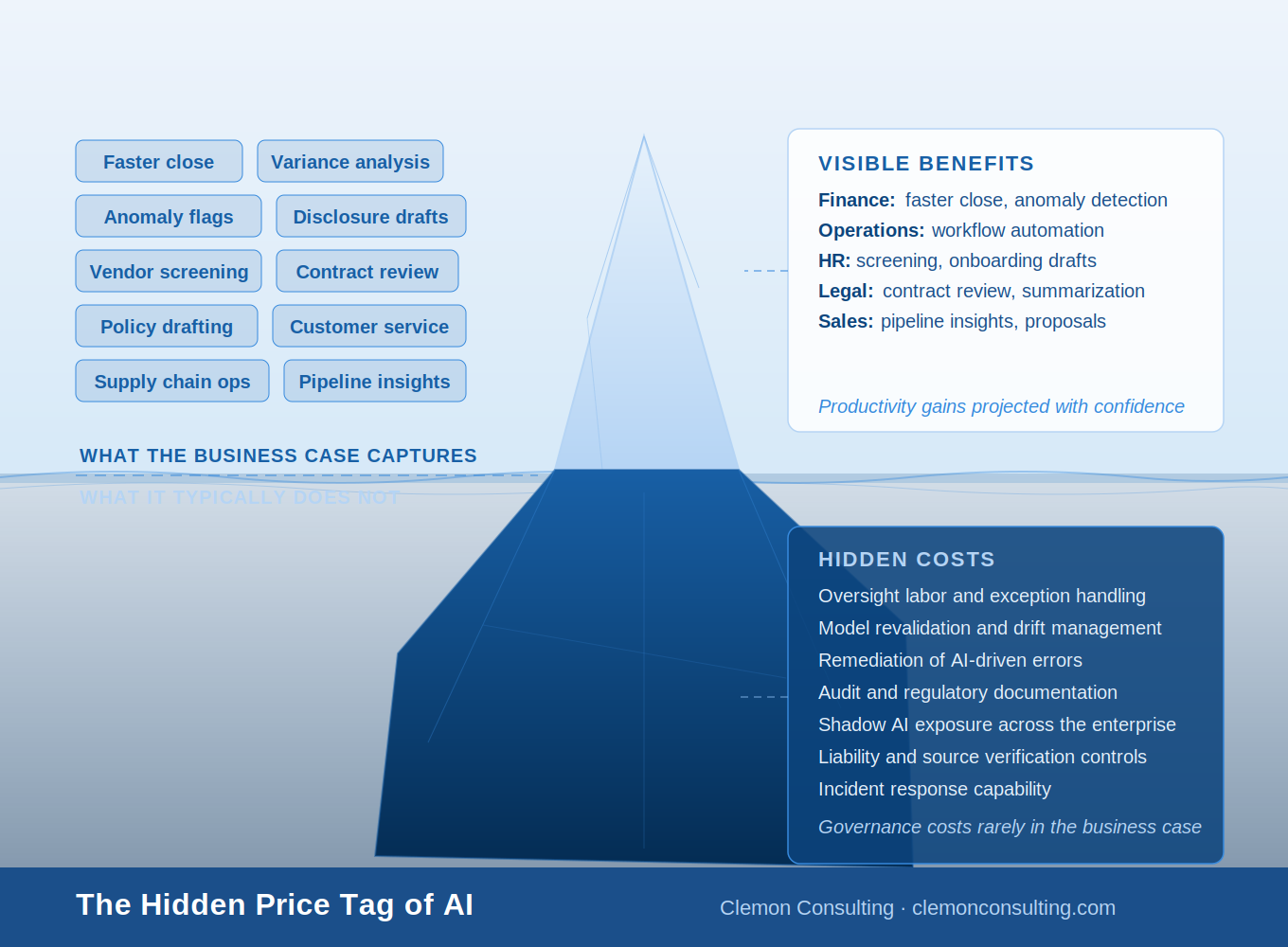
The Hidden Price Tag of AI
The Hidden Price Tag of AI
Every AI business case captures the efficiency gains with care and the governance costs with optimism. That asymmetry is where implementations go wrong.
Artificial intelligence is being adopted across finance, accounting, and enterprise operations at a pace that has outrun the governance frameworks designed to keep it in check. The productivity story is real. But every efficiency gain sits alongside a risk that rarely appears in the business case: oversight labor, model revalidation, remediation costs, audit documentation, and liability exposure that can dwarf the license fee.
The organizations that navigate AI adoption well are not those that move fastest. They are those that treat governance, human oversight, and control design as core inputs to the investment decision, not afterthoughts.
Read our full blog post for the key risks, the human-in-the-loop framework, and what it means when AI does not know it is wrong.

2026 Corporate Fundraising Environment in the U.S.: Trends in Technology, Software & Life Sciences
The U.S. corporate fundraising environment in 2026 is defined by concentration, selectivity, and strategic capital deployment. Across technology, software, and life sciences, investors are backing fewer companies — but writing larger checks for those that demonstrate clear differentiation, strong fundamentals, and long-term scalability. Artificial intelligence, deep tech, and clinically validated innovation continue to attract outsized attention, while traditional growth narratives face higher scrutiny.
As capital providers raise expectations around execution, profitability, and strategic fit, companies must adapt their fundraising approach to align with how investors are deploying capital today. Understanding these dynamics is now essential for founders and executives preparing for their next raise in an increasingly competitive market.