The Hidden Price Tag of AI
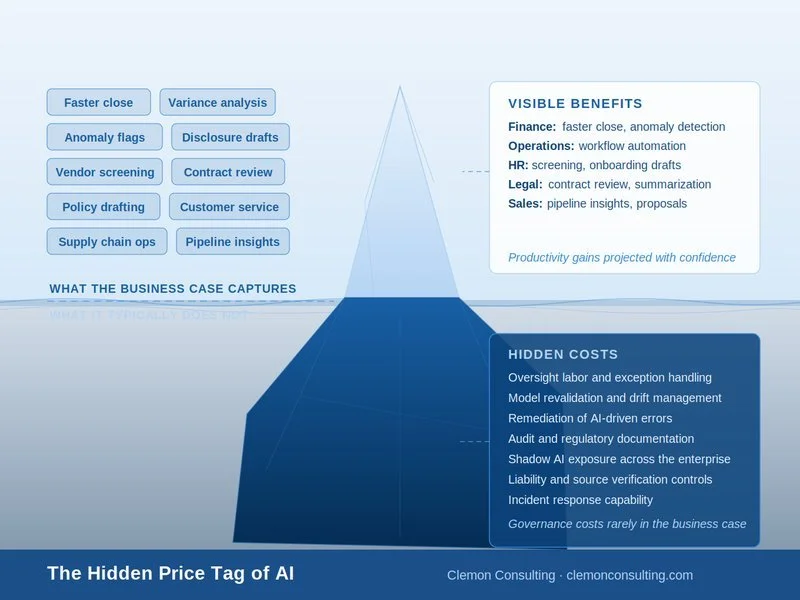
Most AI business cases capture the efficiency gains with care and the governance costs with optimism. That asymmetry is where implementations go wrong.
Artificial intelligence is being adopted across finance, accounting, and enterprise operations at a pace that has outrun the governance frameworks designed to keep it in check and your company in compliance. The productivity story is real: operational efficiencies, faster closes, sharper anomaly detection, automated drafting of variance commentary and disclosure language. But every efficiency gain sits alongside a risk that rarely appears in the business case.
The organizations that navigate AI adoption well are not those that move fastest. They are those that treat governance, human oversight, and control design as core inputs to the investment decision, not afterthoughts. This post summarizes the key risks and the framework for addressing them. For the complete analysis, including a detailed risk narrative, human-in-the-loop design guidance, and a prevent-and-detect control architecture.
This blog post is an abbreviated version of our free downloadable whitepaper on topic.
The ROI Calculation Is Incomplete Without Governance Costs
AI business cases routinely project efficiency gains with precision and treat governance costs as nominal. That is an error. A complete ROI model must include: dedicated staff for output review and exception handling; periodic model revalidation by personnel who understand both the technology and the business domain; documentation sufficient for audit and regulatory review; and incident response capability when the model produces something wrong.
None of these costs disappear as the model matures. As AI is deployed across more processes, the aggregate oversight burden grows. Organizations that omit these inputs are not being conservative. They are being inaccurate.
THE WHOLISTIC ROI TEST
Before approving an AI deployment, ask: does the business case include the cost of human review, exception handling, model validation, audit documentation, and incident response? If those line items are absent or nominal, the analysis is incomplete. The efficiency gains may still justify the investment, but that judgment should be made with full information.
Human-in-the-Loop Is a Design Decision, Not a Default
The most common failure pattern in AI deployments is not a dramatic system failure. It is a quiet drift from genuine human review to checkbox compliance. Reviewers get busy, nothing has gone wrong recently, and the approval step becomes a formality.
Human-in-the-loop (HITL) must be designed deliberately for each application and each process, with clear answers to four questions: what is being reviewed, by whom, at what frequency, and what happens when the reviewer identifies a problem. Those requirements should be documented and tested as formal controls. For high-stakes processes, including material accounting estimates, tax positions, and disclosure language, the standard should be human-in-command: AI produces a draft and a qualified human makes every decision. For high-volume, lower-risk work, human-on-the-loop oversight with real-time monitoring may be appropriate. The distinction matters and should be made explicitly, not by default.
AI Does Not Know When It Is Wrong
Large language models are trained to produce confident, coherent, helpful-sounding responses. They are not trained to flag uncertainty. The result is a system that produces authoritative-looking output whether the underlying information is accurate or fabricated.
This creates two specific risks that are particularly acute in finance and compliance contexts.
Fabricated sources. AI systems routinely generate citations that do not exist: FASB ASC sections with incorrect codification numbers, SEC release numbers attributed to the wrong year, PCAOB standards that were never issued. These citations look real. They are formatted correctly. They are presented with the same confidence as accurate information. Every AI-generated document that includes a regulatory reference or citation to external authority must be independently verified before it is relied upon. If a source cannot be located in its original form, the content relying on it must be revised or removed.
Outdated references. AI models have a training data cutoff. Their knowledge of accounting standards, regulatory guidance, and enforcement priorities is frozen at a point in the past, often a year or more before deployment. The model will not flag that its answer may be stale. In fast-moving areas, including technical accounting, tax law, securities regulation, and ESG reporting, any AI-generated content referencing regulatory requirements must be verified against the current version of the source document at the time of use.
SOURCE VERIFICATION IS A REQUIRED CONTROL
Treat every AI-generated regulatory or legal reference as unverified until independently confirmed. The reviewer's job is not to assess quality. It is to locate and confirm every cited source in its original, current form. This is not optional review. It is a hard control requirement.
Where the Significant Risks Concentrate
In finance and accounting, the highest-consequence risk areas are: fabricated or miscalculated financial outputs in unstructured tasks such as MD&A drafting and technical memos; model drift in fraud and anomaly detection as business conditions change; data leakage of sensitive financial information through ordinary use of external AI tools; and AI-assisted disclosure language that reflects outdated regulatory requirements.
Across the enterprise, the risks that most frequently produce control failures are: shadow AI proliferation, where employees adopt unapproved tools faster than governance frameworks develop; accountability gaps, where no individual or function is clearly responsible when AI output causes harm; workforce skill atrophy, where professionals lose the ability to perform or critically evaluate tasks that AI now handles; and AI-enabled payment fraud, where synthetic voice and deepfake technology is used to impersonate executives and authorize wire transfers.
Each of these risk areas requires both preventive controls, designed to stop problems before they occur, and detective controls, designed to identify them after the fact. The ratio of preventive to detective effort should increase with the risk level of the process. For the complete risk narrative and control framework, see our full whitepaper.
A Note on Accountability: The Signature Still Belongs to You
No AI vendor indemnification clause survives a restatement conversation with investors, sponsors, creditors, the SEC, your auditors, or your board. When AI assists in financial reporting, the accountability for accuracy remains with the humans who reviewed and approved the output. This means human review must be genuine, documented, and defensible, not a formality.
External auditors are already asking which processes are AI-assisted, what human oversight exists, and how model reliability is assessed. Organizations that have not built this documentation into their governance will be constructing it reactively during fieldwork, which is an expensive and stressful time to start. The segregation of duties question has also expanded: the team that builds and maintains the model should not be the same team that reviews its outputs without independent oversight.
WORK WITH CLEMON CONSULTING
We can help you get ahead of AI governance risk
Download our full whitepaper, The Hidden Price Tag of AI, for the complete risk and control framework, HITL design guidance, and governance architecture your organization needs.
Explore Our Services → clemonconsulting.com/services
AI Risk & Controls Assessment • SOX & Internal Audit Readiness • M&A Advisory • Enterprise Risk Management • Fractional and Interim CFO & Controller • Business Transformation • M&A Advisory
Contact Us Today → contact@clemonconsulting.com
This post summarizes themes from our full whitepaper, The Hidden Price Tag of AI, available at clemonconsulting.com. It is provided for informational purposes and reflects general best practices in enterprise AI governance and internal controls. Organizations should engage qualified advisors when designing AI governance frameworks specific to their industry, regulatory environment, and risk profile. © Clemon Consulting, clemonconsulting.com/whitepapers